New SaaS products
Turn a validated scope into tenant-aware workflows, subscriptions, administration, APIs, and a production release path.
Engineering service · Bangladesh and worldwide
Binnash builds and improves Laravel SaaS products from Dhaka, combining application architecture with practical product delivery. Engagements can cover multi-tenant systems, APIs, billing, permissions, queues, integrations, dashboards, performance, testing, deployment, and the operating tools a team needs after launch, for established teams and new ventures.
By Nazmul Alam · Reviewed
01
This service fits products where business rules, permissions, data, integrations, and operating workflows matter more than a static presentation layer. It covers both new applications and existing Laravel systems that need safer delivery, clearer architecture, or accountable technical ownership.
Turn a validated scope into tenant-aware workflows, subscriptions, administration, APIs, and a production release path.
Replace fragile spreadsheets or manual handoffs with permissions, workflows, reporting, imports, exports, and integrations.
Audit and improve architecture, tests, queues, performance, security boundaries, deployment, and observability without assuming a rewrite.
Plan staged movement of data and workflows where compatibility, reconciliation, cutover, and rollback require explicit ownership.
02
Binnash connects domain rules to the product experience and production environment. The scope identifies who can do what, how state changes, where data belongs, what external systems are authoritative, and how operators recover when something fails.
Deliverables can include discovery, architecture, domain modeling, product UX, responsive interfaces, APIs, authentication, permissions, multi-tenancy, billing, integrations, queues, notifications, reports, imports, exports, administration, automated tests, observability, deployment, documentation, and handover.
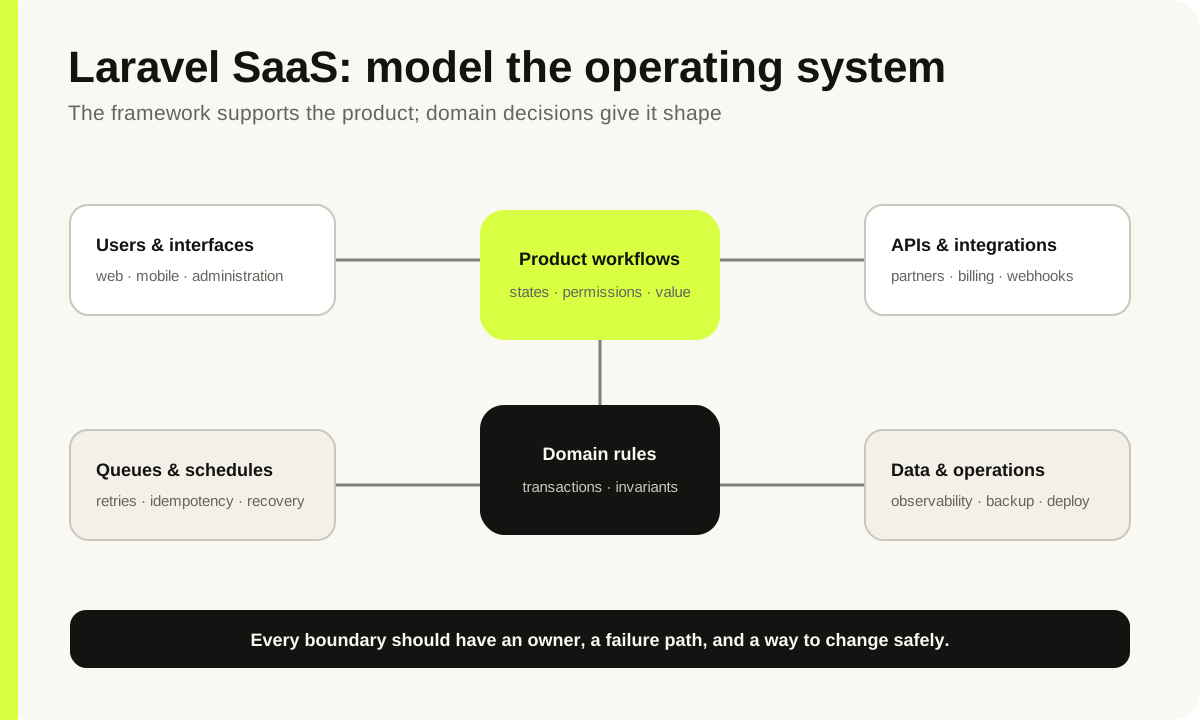
Model the decisions, states, permissions, validation, and audit history that make the product useful.
Tenancy, plans, subscriptions, entitlements, usage limits, invoices, and operator exceptions where required.
Versioned APIs, webhooks, queues, retries, scheduled tasks, idempotency, and visibility into failed work.
Tests, deployment automation, configuration, monitoring, logs, backups, documentation, and access under an agreed ownership model.
03
The work begins with the workflows and data boundaries that can invalidate the architecture or estimate. Delivery then proceeds in reviewable vertical slices so product behavior, implementation, and operational readiness can be assessed together.
04
Existing code changes the estimation method. Binnash does not quote a major takeover from screenshots or a feature list alone; repository access, environments, dependencies, test coverage, data, deployment, and operational history must be reviewed.
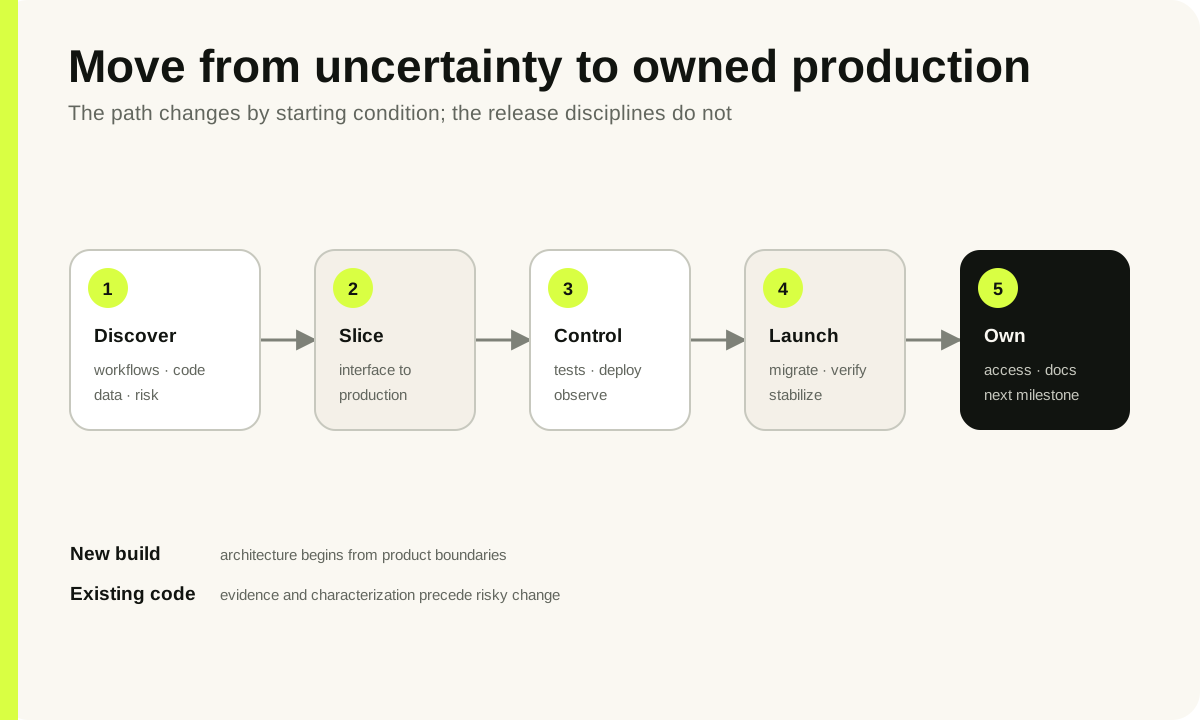
| Starting condition | First useful step | Main uncertainty |
|---|---|---|
| New product with a defined scope | Architecture and a thin end-to-end workflow | Domain boundaries and release scope |
| Existing healthy Laravel application | Codebase review plus a bounded delivery milestone | Local conventions, dependencies, release process |
| Legacy or weakly tested application | Technical audit and characterization tests around critical paths | Regression risk and hidden coupling |
| Migration from another system | Data and workflow inventory with rehearsal plan | Mapping, reconciliation, cutover, rollback |
| Performance or reliability problem | Measurement-led diagnosis before optimization | Workload shape, bottleneck location, production evidence |
05
Quality is not measured by framework fashion. It is the ability to change important workflows with confidence, operate them under real load, understand failures, and transfer ownership without relying on hidden knowledge.
Names, boundaries, validation, state changes, authorization, and transaction rules reflect how the business actually operates.
Feature and unit tests focus on valuable behavior, permissions, billing, integrations, queues, and regressions rather than test counts alone.
Queued and scheduled tasks have retries, timeouts, idempotency, failure visibility, and an operator recovery path appropriate to their impact.
Environment configuration, deployment, migrations, cache and queue restarts, monitoring, backups, and rollback expectations are documented.
06
A focused Laravel application or internal tool is commonly planned over 4–8 weeks. A SaaS MVP is commonly planned over 10–20 weeks, while a complex platform or migration can require 5–12+ months. Domain complexity, tenancy, permissions, billing, integrations, data, reporting, test depth, and release constraints determine the real schedule.
Indicative Binnash Laravel ranges begin around $1,500–$5,000 (BDT 2–6 lakh) for a focused application or internal tool. SaaS products and platform migrations use broader planning tiers. These are planning ranges, not fixed quotations or Bangladesh market averages.
The engineering range can include discovery, necessary product UX, implementation, scope-appropriate testing, deployment, documentation, handover, and 90 days of defect correction and launch stabilization. Applicable taxes, hosting, licenses, payment fees, content, and unlisted migration or integration work remain separate.
Review the Laravel development cost guide for all three planning tiers and the assumptions behind them.
07
A good Laravel brief explains the product behavior and operating environment. Existing systems should include enough technical evidence to distinguish a bounded feature engagement from an audit or stabilization phase.
For a new commercial product whose scope is still uncertain, compare MVP product development . For supplier evaluation and proposal questions, use the Bangladesh software-company hiring guide .
Sources
External facts and conversion guidance should be checked against these primary sources at decision time.
FAQ
Yes, after a proportionate codebase and production review. The first engagement may be an audit, stabilization milestone, or bounded feature depending on tests, architecture, dependencies, deployment, data, and known incidents. Binnash does not assume a rewrite is necessary without evidence.
Only when the product actually serves separate customer organizations or isolated account spaces. Tenancy can affect data access, domains, configuration, billing, reporting, jobs, storage, and administration, so the required isolation model should be defined early rather than added as a label.
Yes. API work can include authentication, authorization, versioning, validation, pagination, rate limits, idempotency, webhooks, documentation, tests, and operational monitoring. The scope depends on the consumers and compatibility commitments rather than the endpoint count alone.
Testing is proportional to product risk. Binnash prioritizes critical workflows, permissions, billing, data boundaries, integrations, queued work, and regressions. Existing systems may first need characterization tests around behavior that cannot safely change without coverage.
Yes, but performance work starts with evidence. Request traces, slow queries, queue metrics, cache behavior, error logs, infrastructure limits, traffic shape, and reproducible workloads where available. Optimization should target a measured bottleneck rather than apply generic caching or infrastructure changes.
The proposal and handover define ownership explicitly. Client code, repositories, production accounts, credentials, domains, and data should remain accessible under the agreed ownership model. Third-party licenses and pre-existing intellectual property are identified separately.
Start with context
Share the current stage, constraint, timeline, and approved budget band. The senior team will reply with the right next step.