A focused AI workflow
Add extraction, classification, drafting, support, search, review, or automation to a defined business process.
Engineering service · Bangladesh and worldwide
Binnash designs and builds AI-enabled products from Dhaka for teams in Bangladesh and worldwide. The work can include model integration, retrieval, tool use, agent workflows, OpenAI-compatible APIs, evaluation, observability, and the conventional product engineering required to make an AI capability reliable and usable.
By Nazmul Alam · Reviewed
01
This service fits when model behavior must create a dependable product outcome, not merely demonstrate that an API can return text. The core question is whether AI can perform inside a real workflow with acceptable quality, latency, cost, safety, and operating effort.
Add extraction, classification, drafting, support, search, review, or automation to a defined business process.
Build governed search or answer generation over documents, records, product data, or internal knowledge.
Let a model select and call approved tools while permissions, confirmation, traces, and failure handling remain explicit.
Provide model access, routing, billing, usage controls, developer experience, and operational visibility through a conventional application layer.
02
A production AI feature has three connected systems: the user-facing product, the model workflow, and the software that controls identity, data, jobs, cost, and operations. Binnash scopes the smallest complete slice rather than treating the model call as the product.
Deliverables can include product discovery, workflow mapping, architecture, proof-of-capability prototypes, prompts, structured outputs, retrieval pipelines, tool integrations, model routing, evaluation sets, guardrails, human review, administration, observability, deployment, documentation, and handover.
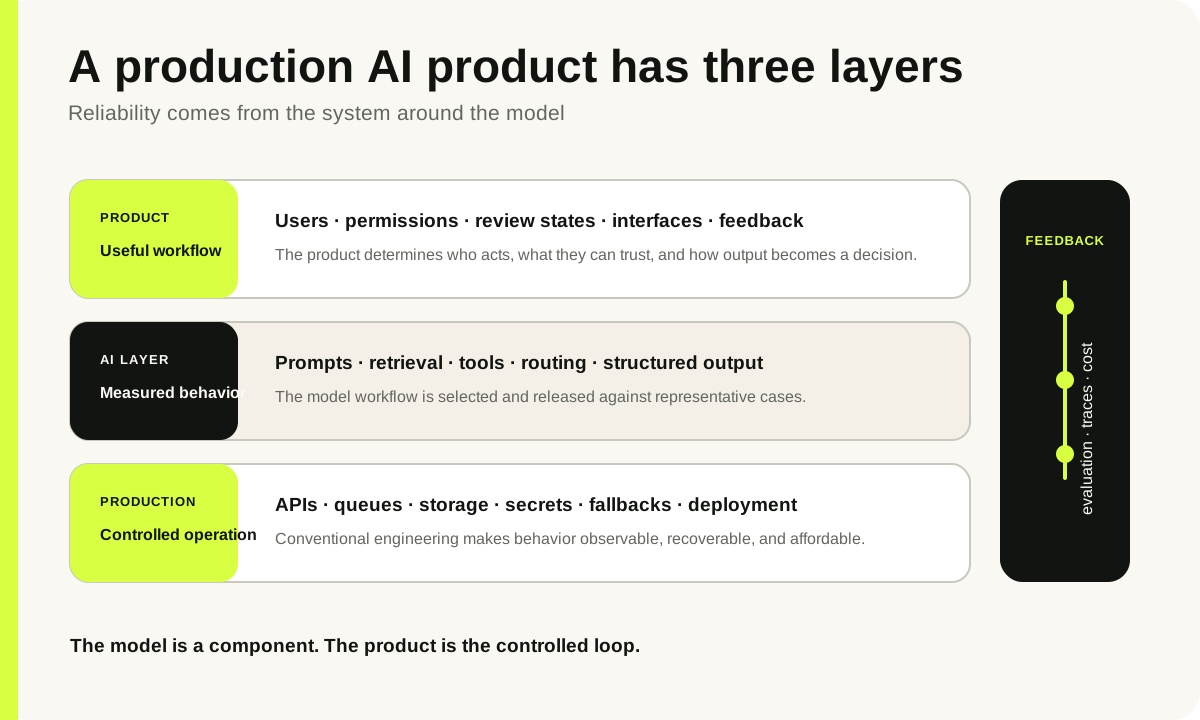
User journeys, permissions, review states, feedback, interfaces, analytics, and the conventional workflows surrounding AI output.
Prompts, context construction, retrieval, tools, provider selection, structured responses, evaluation, and cost controls.
APIs, queues, storage, secrets, rate limits, monitoring, fallbacks, audit traces, deployment, and incident visibility.
03
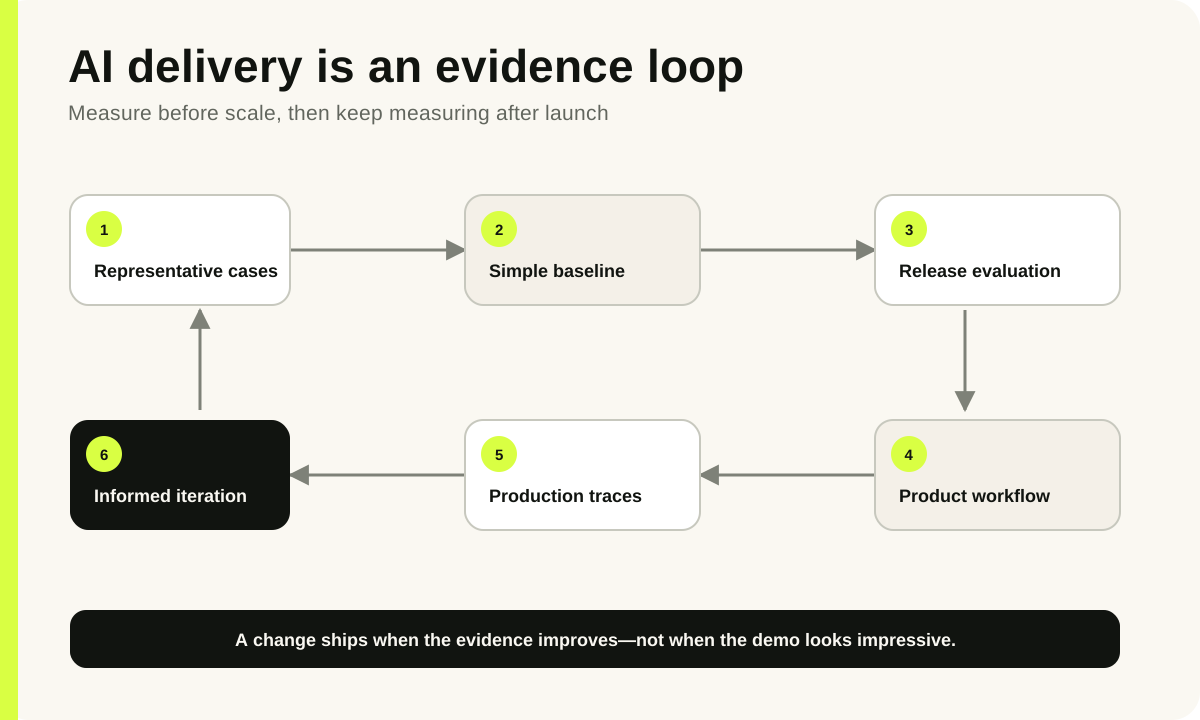
AI uncertainty should be reduced in the order that can invalidate the project fastest. Binnash first defines the behavior worth measuring, then tests it on representative cases before investing in a broader application.
04
RAG, agents, MCP tools, and multi-provider routing are means, not default requirements. The architecture should be the least complex design that meets the evidence, permission, freshness, and operating needs of the workflow.
| Pattern | Use it when | Primary engineering concern |
|---|---|---|
| Direct model integration | A bounded prompt and structured response can solve the task | Output validation, latency, cost, failure states |
| Retrieval-augmented generation | Answers need governed, current, or private source material | Chunking, retrieval quality, citations, access control |
| Tool-using workflow | The model must read or change external systems | Permissions, confirmation, idempotency, auditability |
| Agentic orchestration | The task requires several conditional steps that cannot be fixed in advance | Run limits, state, recovery, observability, evaluation |
| Provider routing | Availability, capability, geography, or cost requires alternatives | Normalized interfaces, fallbacks, policy, comparable telemetry |
05
A model can be impressive in a demo and still fail as a product. Binnash makes the important acceptance criteria visible and connects each one to an engineering or operating control.
Task-specific evaluation cases, structured validation, groundedness checks, regression tests, and human review where judgment remains necessary.
Explicit source ownership, least-privilege retrieval and tools, secret handling, retention decisions, and separation between tenants or user roles.
Timeouts, retries, queues, rate limits, provider fallbacks, failure states, traces, alerts, and a way for operators to inspect difficult runs.
Usage budgets, model selection rules, caching where appropriate, prompt and model versioning, and evaluation before provider or behavior changes ship.
06
A focused LLM validation prototype is commonly planned over 3–6 weeks. A production AI workflow is commonly planned over 8–16 weeks, while an AI product or platform can require 4–9+ months. Data readiness, evaluation complexity, integrations, permissions, model behavior, and the surrounding application determine the real schedule.
Indicative Binnash AI product ranges begin around $2,000–$4,000 (BDT 2.5–5 lakh) for a focused LLM validation prototype. Production workflows generally require a larger scope. These are planning ranges, not fixed quotations or Bangladesh market averages.
The scoped engineering range can include discovery, necessary product UX, implementation, scope-appropriate testing, deployment, documentation, handover, and 90 days of defect correction and launch stabilization. Model and API usage, data acquisition or cleanup, hosting, paid tools, applicable taxes, and ongoing operations remain separate unless stated.
See the AI product development guide for Bangladesh for all three planning tiers, assumptions, exclusions, and the variables that move an estimate.
07
The strongest starting brief describes the workflow and evidence rather than prescribing an architecture. Share enough context to identify the riskiest assumption and a responsible first milestone.
If the product itself is still being defined, compare this service with MVP product development . If you are evaluating delivery partners, use the software-company selection guide to test proposals, ownership, and evidence.
Sources
External facts and conversion guidance should be checked against these primary sources at decision time.
FAQ
Yes. A focused validation engagement can test a defined workflow, representative cases, model or retrieval choices, latency, and approximate usage cost. The prototype should answer a decision question; it is not presented as production-ready unless reliability, security, operations, and handover are explicitly in scope.
No. A direct model call with structured output may be sufficient for a bounded task. RAG is useful when governed source material matters, and tool use is useful when the model must interact with other systems. Agentic orchestration adds operating complexity and should be justified by the workflow.
Binnash defines task-specific cases, expected properties, unacceptable failures, and release thresholds with the product owner. Automated checks, model-based evaluation, structured validation, and human review can be combined. The evaluation design depends on the real decision and risk rather than one generic accuracy score.
No, provider usage is separate from engineering unless a proposal explicitly says otherwise. The estimate distinguishes application engineering, model or API consumption, data work, hosting, and paid tooling so the team can understand both build cost and ongoing operating cost.
Potentially, after the data sources, ownership, sensitivity, access rules, retention needs, hosting constraints, and provider terms are reviewed. The project must define who may access which material and what can be sent to external providers. Binnash does not make unsupported compliance claims.
Yes. An audit can examine prompts, retrieval, tools, evaluation coverage, traces, latency, provider usage, failure modes, application architecture, security boundaries, and operator visibility. The audit scope and decision deliverables are agreed before access is granted.
Start with context
Share the current stage, constraint, timeline, and approved budget band. The senior team will reply with the right next step.