Software buyer guide · Bangladesh

AI product development in Bangladesh: plan the system, not just the prompt.

Binnash AI product engagements typically plan from about $2,000–$4,000 (BDT 2.5–5 lakh) for an LLM validation prototype, $4,000–$12,000 (BDT 5–15 lakh) for a production AI workflow, and $12,000–$36,500+ (BDT 15–45+ lakh) for an AI product or platform. Model usage, data preparation, hosting, and specialized compliance remain separate.

Start a project

By Nazmul Alam · Reviewed

01

Binnash AI product planning ranges

AI product cost depends on the responsibility around the model. Calling a hosted API is a small technical step; discovering a useful workflow, grounding outputs, evaluating quality, controlling tools, protecting data, managing cost, and operating a reliable application are the product-engineering work.

The tiers below focus on LLM products: model APIs, retrieval-augmented generation, agents, MCP and tool integrations, evaluation, guardrails, observability, and the conventional web or SaaS application around them. They do not claim custom foundation-model training, computer-vision research, or a general data-science practice.

The delivery baseline includes 90 days of defect correction and launch stabilization; continuing evaluation, prompt changes, and new workflows are separate.

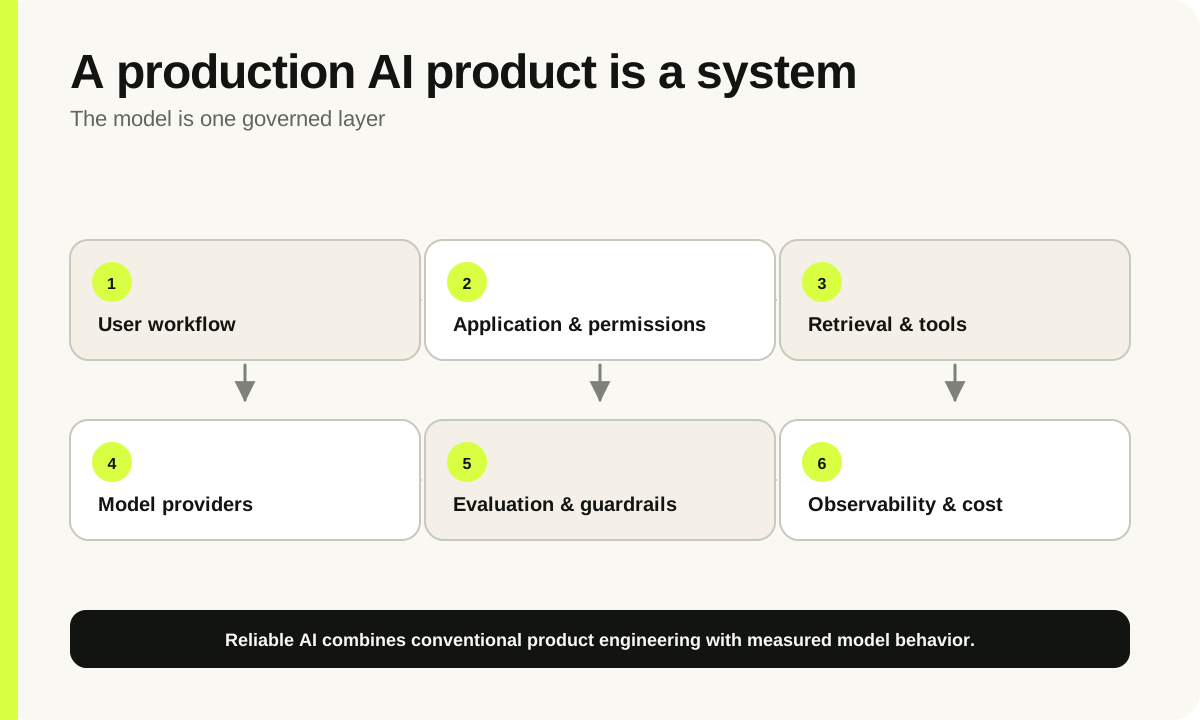
AI product architecture showing the user workflow, application layer, retrieval and tools, model providers, evaluation, and observability
The model is one layer in a production AI product; controls and conventional application engineering surround it.

3–6 weeks

LLM Validation Prototype

≈$2,000–$4,000

BDT 2.5–5 lakh

For testing whether an LLM can perform one valuable workflow with representative inputs, a basic interface, and an explicit evaluation method.

Assumes

  • One focused workflow and controlled users
  • Accessible sample data and subject-matter review
  • Hosted model APIs rather than custom model training

What moves the estimate

  • Data readiness and evaluation-set creation
  • Retrieval, tool use, and external integrations
  • The consequence and detectability of wrong outputs

8–16 weeks

Production AI Workflow

≈$4,000–$12,000

BDT 5–15 lakh

For a real customer or staff workflow with authentication, product UI, retrieval or tools, evaluation, monitoring, fallbacks, and production deployment.

Assumes

  • Validated workflow and named product owner
  • Defined data access and user permissions
  • A manageable number of tools and business systems

What moves the estimate

  • RAG quality, source permissions, and citations
  • Tool permissions, approval steps, and auditability
  • Provider routing, latency, cost, and fallback behavior

4–9+ months

AI Product or Platform

≈$12,000–$36,500+

BDT 15–45+ lakh

For a multi-user AI product, API platform, agent system, or AI-enabled SaaS with several workflows, integrations, operational controls, and an ongoing roadmap.

Assumes

  • Phased delivery and prioritized product releases
  • Available domain experts and data owners
  • Explicit operating, security, and quality ownership

What moves the estimate

  • Multi-tenancy, billing, usage accounting, and APIs
  • Several agents, tools, providers, or data domains
  • High-stakes decisions, compliance, scale, and support
Planning range summary. BDT is the commercial source of truth; USD is rounded for comparison.
Delivery tier USD planning range BDT planning range Planning window
LLM Validation Prototype ≈$2,000–$4,000 BDT 2.5–5 lakh 3–6 weeks
Production AI Workflow ≈$4,000–$12,000 BDT 5–15 lakh 8–16 weeks
AI Product or Platform ≈$12,000–$36,500+ BDT 15–45+ lakh 4–9+ months

02

Choose a workflow before choosing a model

A useful AI product begins with a decision or task that matters to a user. “Add AI” is not a scope. Define the input, desired output, human decision, acceptable error, escalation path, and measurable improvement.

Good early candidates have repeated work, accessible examples, a reviewer who can judge quality, and a way to limit harm. Document search, classification assistance, drafted responses, structured extraction, internal research, and workflow triage can be tested with representative cases before a broad product is built.

Avoid measuring a prototype only through impressive demonstrations. Demonstrations are selected; production receives ambiguous, incomplete, adversarial, and unfamiliar inputs. Build an evaluation set from normal cases, important edge cases, known failures, and examples that require refusal or human review.

A focused proof can begin through the AI product engineering service . For broader budgeting and supplier evaluation, pair this guide with the general software cost guide and the software-company hiring guide .

Define the workflow

  • User, task, and current alternative
  • Inputs, outputs, and source of truth
  • Value of a correct result
  • Cost and consequence of an incorrect result
  • Human approval or escalation point
  • Success and stop criteria for validation

Prepare evidence

  • Representative normal examples
  • Important edge and failure cases
  • Private-data and permission cases
  • Expected refusals and safe fallbacks
  • Domain reviewer and evaluation rubric
  • Baseline from the current process

03

Select the smallest responsible architecture

Hosted models, retrieval, tools, agents, and model routing solve different problems. Adding all of them by default increases cost and failure modes without guaranteeing a better user outcome.

AI architecture choices and when they are justified
Approach Use it when Adds Watch for
Direct hosted model The task uses information already in the request or general model capability Prompting, structured outputs, provider integration, and evaluation Privacy, variable output, latency, availability, and token cost
Retrieval-augmented generation Answers need private, changing, or attributable source material Ingestion, chunking, search, permissions, context assembly, and citations Stale sources, missing context, permission leakage, and false attribution
Tool or MCP integration The model must read or act through controlled business capabilities Schemas, authentication, permissions, approvals, retries, and audit logs Unsafe actions, excessive access, partial failure, and prompt injection
Agent workflow The task genuinely requires planning or several adaptive steps State, tool selection, orchestration, budgets, stop conditions, and tracing Compounding errors, loops, cost, latency, and difficult evaluation
Model routing and fallback Quality, availability, latency, or unit economics justify several models Provider abstraction, policies, normalization, failover, and cost tracking Inconsistent behavior and more operational complexity

04

Retrieval quality is a data and permission problem

RAG does not automatically make a model accurate. The product must decide what content is authoritative, who may access it, how it is segmented and indexed, when it becomes stale, and how a user can inspect the supporting source.

A retrieval pipeline may include document inventory, parsing, cleanup, metadata, chunking, embeddings, search, re-ranking, context assembly, citations, and an update process. Each stage can remove or distort information. Representative retrieval tests should be separated from answer-quality tests so the team knows whether a failure came from search or generation.

Permissions must be enforced before private content reaches the model. Filtering a citation after generation is not a security boundary. For multi-tenant or role-based products, source access, caches, logs, traces, and exports must respect the same data boundaries as the conventional application.

05

Evaluation is part of the product

AI behavior is probabilistic and provider models change. Production confidence comes from repeatable evaluation, not from one approved prompt.

Start with task-specific criteria: correctness, completeness, groundedness, format compliance, tool choice, refusal, tone, or reviewer time saved. Not every criterion can be automated. Use deterministic checks where possible and structured human review where judgment is required.

For high-impact workflows, define a human approval step or safe fallback. The right boundary depends on whether the output drafts text, recommends a decision, changes a record, sends communication, moves money, or controls another system. The ability to act should never exceed the product’s permission and review model.

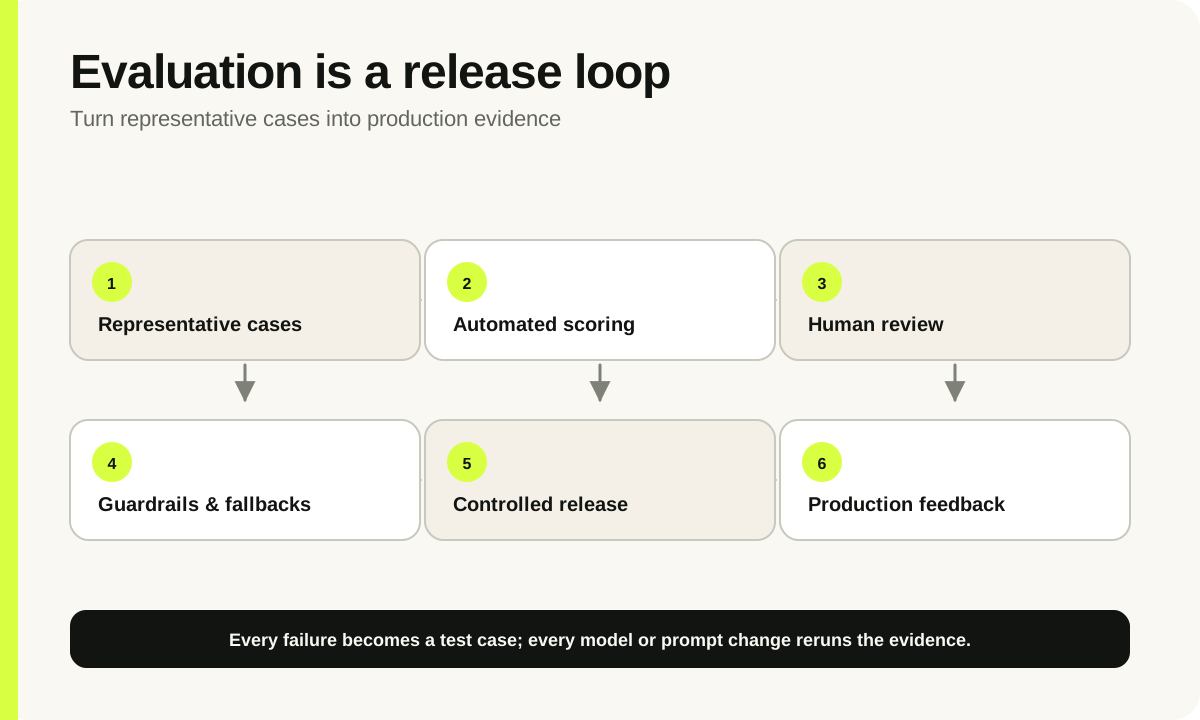
AI evaluation loop from representative cases through scoring, review, guardrails, release, and production feedback
Evaluation is a release loop, not a one-time prompt test.
Evaluation layers for an AI product
Layer Example question Evidence
Deterministic behavior Is the schema valid and are required fields present? Automated assertions and contract tests
Retrieval Did the system find the permitted authoritative source? Recall tests, ranked results, and citation checks
Response quality Is the answer correct, complete, and grounded? Rubric-based model and human review
Tool behavior Was the correct tool used with safe arguments? Traces, permission tests, and simulated failures
Product outcome Did the workflow improve time, quality, or completion? User research, operational metrics, and comparison to baseline

06

Agents and tools require conventional controls

An agent that can call tools is an application with delegated authority. It needs authentication, permission checks, validation, budgets, timeouts, retries, idempotency, auditability, and a recovery path.

MCP can provide a consistent way to expose tools and context, but it does not decide whether a user is allowed to perform an action. The application must map authenticated users and tenants to allowed tools, resources, parameters, and approval requirements.

Treat model-generated tool arguments as untrusted input. Validate them against server-side rules, limit data access, protect secrets, and require confirmation for consequential actions. Log decisions and results at a level that supports debugging and review without storing sensitive content unnecessarily.

07

Separate engineering cost from AI operating cost

The project price builds and launches the product. Provider and infrastructure costs continue with usage. A credible budget models both.

Bangladesh teams may pay global providers in foreign currency, so model choice and consumption can affect both architecture and commercial operations. The product should track usage by feature, tenant, or customer where those costs matter to pricing.

One-time and recurring AI product costs
Cost area Usually project scope Usually recurring or separate
Product engineering Discovery, UX, application, integrations, evaluation, deployment Ongoing roadmap and maintenance
Model providers Initial integration and cost controls Input/output tokens, fine-tuning, batch jobs, or reserved capacity
Retrieval and data Pipeline and initial supported dataset Embedding, search, storage, document updates, and data operations
Observability Tracing, dashboards, alerts, and launch setup Log, trace, analytics, and retention consumption
Domain review Agreed evaluation and acceptance participation Continuous labeling, quality review, and policy updates
Security and compliance Normal secure delivery responsibilities Independent audits, legal review, certification, and specialized controls

08

A production AI delivery process

Binnash moves from workflow evidence to a supported product in stages. Each stage has a decision, not merely a list of technical tasks.

Discover and validate

  • Define the workflow, user, harm, and success measure
  • Inventory data, permissions, providers, and integrations
  • Create representative evaluation cases
  • Prototype the riskiest behavior
  • Decide whether evidence supports production investment

Build and operate

  • Design product roles, UI, and approval paths
  • Implement retrieval, tools, and provider controls
  • Automate evaluations and conventional tests
  • Add tracing, usage, failure, and cost monitoring
  • Deploy gradually and review real production cases

09

Security, privacy, and vendor risk

Before sending data to a model or retrieval service, understand what is transmitted, where it is processed, how it is retained, who can access it, and whether the provider may use it for service improvement.

Minimize sensitive data, separate tenants, redact where appropriate, and avoid placing secrets in prompts or tool context. Access control, audit logs, deletion, backups, incident response, and data export remain application responsibilities.

A Bangladesh-based delivery team may still use model, vector, observability, or cloud providers outside Bangladesh. The buyer should approve what data may leave its environment, provider retention settings, account ownership, billing currency, service regions, deletion behavior, and the fallback path before production data is connected.

High-stakes legal, medical, financial, employment, safety, or regulated use requires specialist review beyond ordinary product engineering. The project scope should identify the responsible experts and independent assurance rather than implying that model integration creates compliance.
Sources

Authoritative references

External facts and conversion guidance should be checked against these primary sources at decision time.

FAQ

Useful questions, answered directly.

How much does AI product development cost at Binnash?

Indicative planning ranges are about $2,000–$4,000 (BDT 2.5–5 lakh) for an LLM validation prototype, $4,000–$12,000 (BDT 5–15 lakh) for a production AI workflow, and $12,000–$36,500+ (BDT 15–45+ lakh) for an AI product or platform. A scoped proposal confirms the actual responsibility.

Are model API and token costs included?

No, unless a proposal explicitly includes a fixed allowance. Model tokens, embeddings, search, storage, hosting, data operations, and other provider charges are usage costs. Binnash can implement measurement, limits, and cost controls as part of the product.

Does every AI product need RAG?

No. RAG is useful when the product needs private, changing, or attributable source material. It adds ingestion, search, permissions, citations, update operations, and evaluation. A direct model call is simpler when the request already contains the necessary context.

When should an AI workflow use an agent?

Use an agent when the task genuinely needs adaptive planning or several tool-driven steps. Prefer deterministic workflows when the sequence is known. Agents add compounded errors, latency, cost, permissions, tracing, stop conditions, and evaluation responsibilities.

Can Binnash train a custom foundation model?

These published services focus on LLM product engineering: model APIs, RAG, agents, MCP and tools, evaluation, guardrails, observability, and the surrounding application. Custom foundation-model training or a research programme is not included in these ranges.

What is included in the 90-day AI support period?

It covers defects against the accepted product scope and launch stabilization. It does not include unlimited prompt tuning, new workflows, ongoing data labeling, continuous evaluation, model-provider charges, or an open-ended product roadmap.

What should I prepare for an AI project estimate?

Bring the user workflow, representative examples, desired output, current alternative, source data, permissions, integrations, expected volume, cost constraints, failure consequences, domain reviewer, and the evidence that would justify moving from validation to production.

Start with context

Have a product decision to make?

Share the current stage, constraint, timeline, and approved budget band. The senior team will reply with the right next step.

Send a project brief