Software buyer guide · Bangladesh

How to hire a software development company in Bangladesh.

Hire a software development company in Bangladesh by verifying relevant work, the actual delivery team, discovery quality, release process, security practices, commercial assumptions, and your ownership of code, data, domains, and infrastructure. Compare the same outcome and risk—not isolated hourly rates—and reject proposals that hide scope, responsibilities, exclusions, or post-launch terms.

Start a project

By Nazmul Alam · Reviewed

01

Start with the outcome—not a list of company claims

A capable supplier is not simply the company with the longest technology list, the lowest hourly rate, or the most logos. The right choice depends on the product outcome, operating risk, decision speed, and level of ownership you need the team to accept.

Before shortlisting companies, write a one-page buying brief. State who will use the product, the problem or business process, the outcome expected from the first release, the current workaround or system, known integrations, the decision deadline, and the approved budget process. This gives suppliers the same starting context and makes their responses easier to compare.

For an established product, include the current stack, repository and infrastructure access, known defects, user volume, release process, data sensitivity, and why the existing team needs help. A company cannot responsibly estimate takeover work from a feature list alone.

Start by checking whether the likely budget matches the software development planning ranges , then compare the supplier’s proposed responsibilities against the relevant Binnash engineering services .

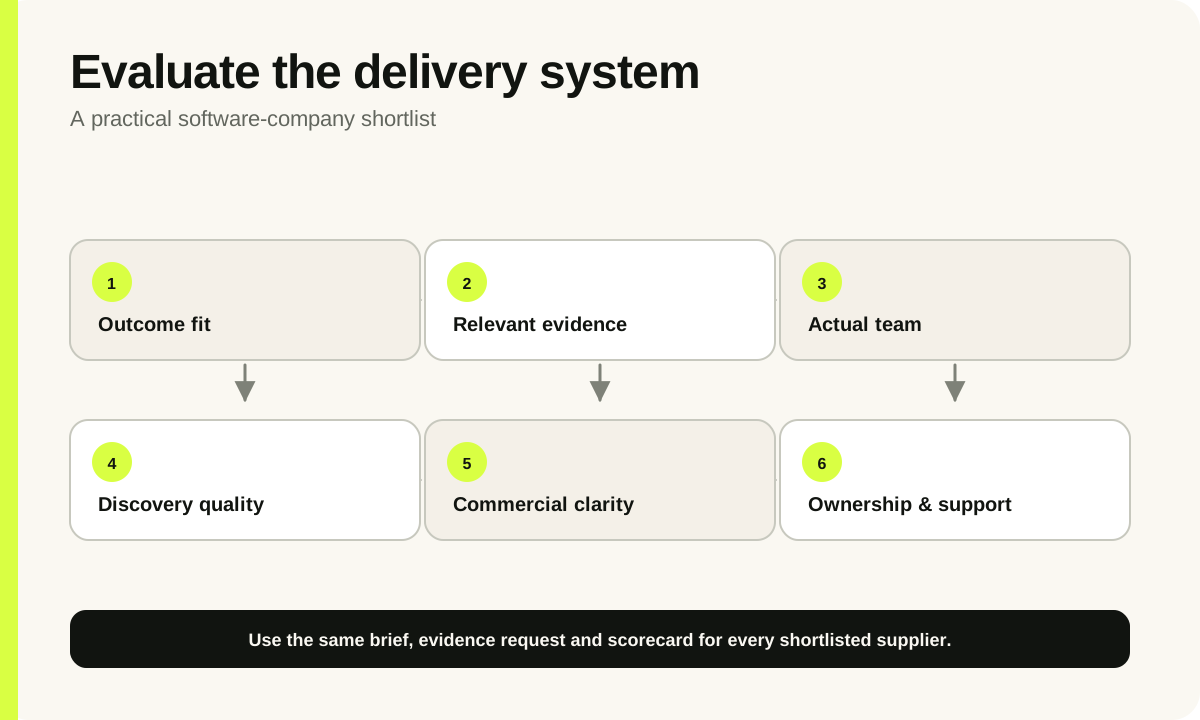
Vendor evaluation sequence covering outcome, evidence, delivery team, commercial clarity, and ownership
A disciplined shortlist tests delivery evidence and ownership—not just presentation quality.

guide

Software development cost in Bangladesh: what actually changes the estimate.

Compare Binnash software development planning ranges, scope tiers, timelines, cost drivers, inclusions, exclusions, and estimation methods in Bangladesh.

Explore Software development cost in Bangladesh

02

Use a buyer scorecard

A scorecard prevents a polished sales conversation from outweighing delivery evidence. Weight the factors according to your risk, then ask every shortlisted company for the same proof.

Software company evaluation scorecard
Criterion Strong evidence Warning sign Suggested weight
Relevant problem experience Work with comparable workflows, risk, or product stage Only generic industry or technology claims 15%
Actual delivery team Named senior people and clear responsibilities Senior sales team but unknown implementers 15%
Discovery quality Questions expose assumptions, dependencies, and exclusions Instant certainty from a short feature list 15%
Delivery visibility Regular demos, written decisions, and reviewable releases Activity reports without working outcomes 10%
Engineering quality Testing, review, security, deployment, and observability are scoped Quality work appears only as an optional extra 15%
Ownership and access Client-controlled repositories, accounts, data, and handover Supplier-controlled assets or hidden credentials 10%
Commercial clarity Scope, assumptions, milestones, exclusions, and change process One total with no boundary or acceptance method 10%
Post-launch responsibility Defined stabilization, incident, maintenance, and transition terms Support promised verbally without coverage 10%

03

Verify evidence instead of counting portfolio logos

A portfolio is useful only when you can understand what the company actually did. A supplier may have designed one screen, provided staff, inherited an existing platform, or delivered the entire product. Those are different kinds of evidence.

Ask which problem the team owned, who participated, what constraints shaped the work, what was delivered, what remains in operation, and which result can be verified. If client confidentiality prevents public detail, the company should still be able to describe an anonymized problem, its role, the decision process, and the technical or operational responsibility without inventing metrics.

Match evidence to your risk. An attractive marketing website does not prove capability in multi-tenant SaaS, data migration, payment reconciliation, AI evaluation, or catalogue performance. Conversely, a supplier does not need an identical industry project if it can demonstrate the same hard problem and explain how the domain differences would be discovered.

Ask about each work example

  • The supplier’s exact role and responsibility
  • The named or comparable delivery team
  • The problem, constraints, and decision process
  • What shipped and what remains operational
  • Which results are measured and verifiable
  • Whether the client approved public attribution

Match evidence to your project

  • Product stage and uncertainty
  • User roles and workflow complexity
  • Integrations and data migration
  • Security and operational exposure
  • Scale, performance, and availability
  • Release and post-launch responsibility

04

Know who will actually do the work

Agency size is less important than team composition, senior access, and responsibility. Ask for the proposed roles and how much of each person’s attention is realistically available.

Clarify who leads product decisions, architecture, design, implementation, quality, deployment, and client communication. One person may cover several roles in a small senior studio, but the responsibilities must still be explicit. For larger teams, understand the management layers between your product owner and the engineers making daily decisions.

Ask whether the team is employed, contracted, or assembled after signature; whether members work on several clients; how replacement is handled; and whether the senior people in discovery remain involved. A low blended rate can hide a team dominated by junior delivery with limited review capacity.

05

Compare commercial models on the same basis

Fixed scope, milestones, monthly capacity, and discovery engagements distribute uncertainty differently. None is automatically better. The model should match how clearly the outcome is understood and who controls priorities.

Do not compare a proposal that includes discovery, design, testing, deployment, documentation, and support with one that includes implementation only. Normalize the quotes by writing down what must still be purchased, supplied by your team, or accepted as risk.

Commercial models for software delivery
Model Best fit What the proposal must define Main buyer risk
Scoped milestones Known outcome and controlled boundary Deliverables, assumptions, acceptance, milestones, exclusions, and changes Treating an unclear brief as fixed without resolving uncertainty
Monthly product engineering Evolving roadmap and continuous prioritization Team shape, capacity, cadence, responsibilities, and termination terms Paying for capacity without active product ownership
Discovery or audit Unknown product, legacy, integration, or migration risk Questions to answer, evidence produced, recommendations, and next decision Buying delivery before the risky facts are known
Staff augmentation Internal leadership already owns product and architecture Role, seniority, availability, management, and replacement Expecting an individual contributor to provide missing product leadership

06

Test the discovery and estimation process

The questions a company asks before quoting reveal how it thinks about delivery. Strong discovery should reduce ambiguity; it should not merely convert your feature list into a larger document.

Look for questions about users, workflows, exceptions, data ownership, failure handling, integrations, security, operating roles, adoption, and the decision the release must enable. Ask which assumptions are most likely to change the estimate and what the supplier needs from you to validate them.

A responsible proposal should identify what is included, what is excluded, what the client supplies, how acceptance works, and how new requirements affect cost and timeline. It should name third-party charges and ownership wherever they can be known. An estimate without assumptions cannot be evaluated when reality changes.

Discovery questions worth hearing

  • What outcome defines a useful first release?
  • Which workflow or integration carries the most risk?
  • Who owns each decision and source of data?
  • What happens when an external service fails?
  • Which deadline is fixed and which scope may move?
  • How will users and operators review the work?

Proposal details worth requiring

  • Scope and explicit exclusions
  • Assumptions and client responsibilities
  • Milestones and acceptance method
  • Timeline and decision dependencies
  • Payment and change-control process
  • Deployment, ownership, support, and handover

07

Protect ownership, access, and handover

Your company should not become dependent on hidden credentials or supplier-controlled infrastructure. Agree ownership before delivery starts, not when the relationship is ending.

The contract and proposal should state who owns custom code, design files, documentation, data, domains, cloud accounts, analytics, email delivery, app-store accounts, payment accounts, and third-party subscriptions. Where a supplier manages an account, define the transfer and access model.

Prefer repositories and production accounts that your organization can access throughout delivery. That does not mean every stakeholder receives administrative privileges; it means ownership and recovery do not depend on one external person. Credentials should be stored and shared through an appropriate secrets process rather than chat messages or personal accounts.

Handover is not a zip file. It should include current source code, deployment information, environment and service inventory, access transfer, known limitations, operational instructions, and a review with the people who will continue the work. If ongoing maintenance is required, define coverage and response expectations separately.

For Bangladesh contracts, the current statutory reference is the Copyright Act 2023, which repealed the Copyright Act 2000. That fact does not replace contract review: ask qualified counsel to confirm how commissioned work, pre-existing components, open-source dependencies, design assets, confidentiality, acceptance, and assignment are handled for the actual parties and jurisdiction.

For a local engagement, confirm the contracting entity and meeting model described on the Bangladesh software development company page ; do not infer ownership terms from office location alone.
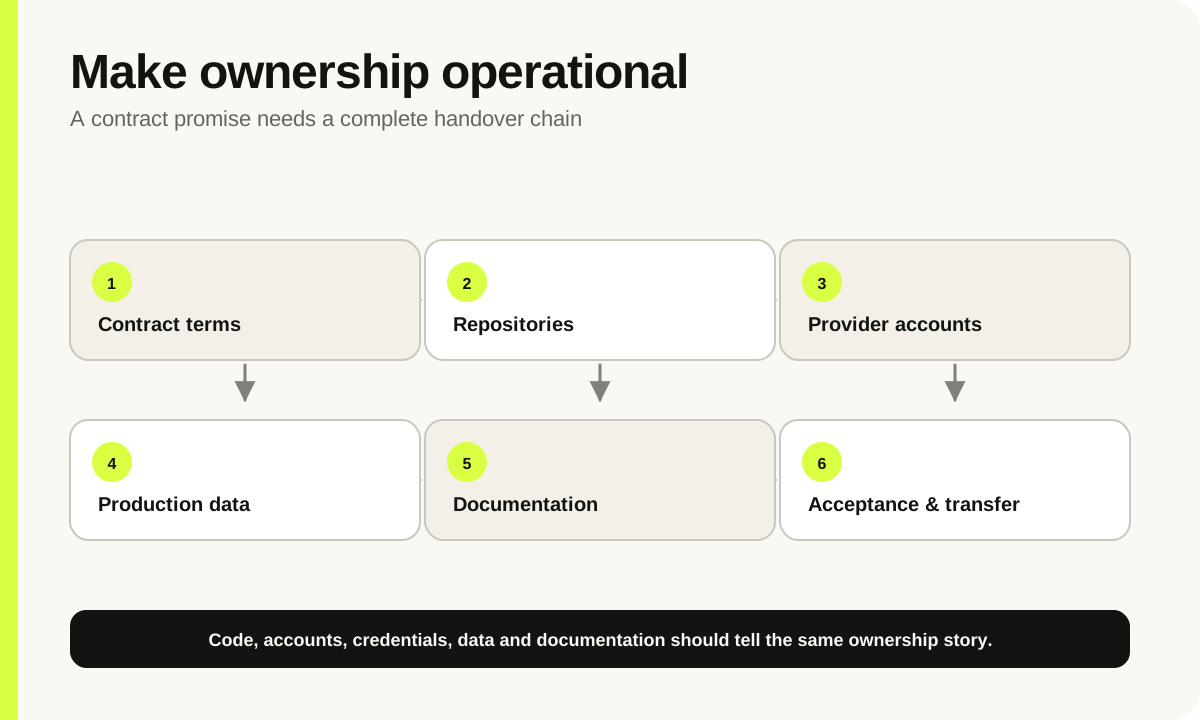
Handover chain covering contract, repository, infrastructure, data, documentation, and acceptance
Ownership is practical only when contracts, accounts, credentials, code, data, and documentation agree.

Assets the buyer should control

  • Source repositories and design source files
  • Domains, DNS, and email administration
  • Cloud, hosting, and deployment accounts
  • Analytics, monitoring, and error tracking
  • Payment, messaging, and external services
  • Production data and documented export paths

Handover should contain

  • Current code and deployment status
  • Environment and external-service inventory
  • Access and ownership transfer
  • Architecture and operational documentation
  • Known issues, risks, and pending decisions
  • A recorded or live knowledge-transfer review

08

Ask practical security and quality questions

Security should be proportional to the data and harm involved, but it should never be reduced to a promise that the developers “follow best practices.” Ask how the practices appear in delivery.

Discuss authentication, permissions, secrets, data protection, dependency updates, code review, testing, backups, logging, incident handling, and recovery. For sensitive systems, ask whether threat modeling, audit trails, penetration testing, compliance review, or data-residency decisions are required and whether those activities are included.

Quality also includes release safety. Ask how changes are reviewed, tested, demonstrated, deployed, monitored, and rolled back. A supplier may use different tools for different products; the important point is that critical behavior and failure paths have an intentional verification process.

09

Recognize common warning signs

One warning sign may have an innocent explanation. Several together usually indicate that the commercial promise is stronger than the delivery system behind it.

Commercial warning signs

  • An exact quote from a broad idea with no assumptions
  • A price that excludes design, testing, deployment, and support without saying so
  • Pressure to sign before meeting the delivery lead
  • Large advance payment without reviewable milestones
  • Verbal promises that do not appear in the proposal
  • No method for handling changes or acceptance

Delivery warning signs

  • No clear owner for architecture or product decisions
  • Unattributed work examples or unsupported metrics
  • Supplier-only access to repositories and production
  • Testing and security treated as optional polish
  • Long gaps without working demonstrations
  • No documented handover or post-launch boundary

10

Run a disciplined final comparison

Shortlist two or three credible companies, give them the same context, and compare written responses against your scorecard. The decision should explain why one operating model and risk allocation fits your product better.

Normalize each quote: add excluded services, expected third-party charges, internal staffing, maintenance, and likely discovery work. Note which assumptions are validated and which could change the price. A lower total with a large undefined boundary may be more expensive than a higher, accountable proposal.

Sources

Authoritative references

External facts and conversion guidance should be checked against these primary sources at decision time.

FAQ

Useful questions, answered directly.

What should I ask a software development company before hiring it?

Ask who will actually lead and deliver the work, what comparable responsibility the team has handled, how it discovers risk, how often you review working software, what testing and security are included, who owns every account and asset, and how scope changes, support, and handover work.

Should I choose the lowest software development quote?

Not without normalizing the scope. Compare discovery, design, engineering, testing, deployment, documentation, third-party costs, support, and client responsibilities. A lower quote may simply transfer more work and risk to your organization or leave essential responsibilities undefined.

Is a fixed-price project better than a monthly engagement?

Fixed milestones fit a defined outcome with a controlled boundary. Monthly product engineering fits an evolving roadmap where priorities change with evidence. Discovery or an audit is safer when important product, legacy, data, or integration facts are still unknown.

Who should own the source code and cloud accounts?

The proposal and contract should state ownership explicitly. For most client products, the client should retain access to the repositories, data, domains, cloud, analytics, payment, and production accounts required to operate or transfer the system.

How can I verify an agency portfolio?

Ask what the agency actually owned, who did the work, which constraints shaped it, what shipped, whether the client approved attribution, and which results can be verified. Match the demonstrated responsibility to your product risk rather than counting logos.

How many companies should I shortlist?

Two or three credible companies are usually enough for a disciplined comparison. Give each the same buying brief, meet the likely delivery lead, normalize the proposals, and score evidence, operating model, ownership, quality, and commercial clarity.

What is a safe first engagement with a new software company?

Choose the smallest engagement that creates a useful decision or delivery result: a codebase audit, focused discovery, validation build, or first milestone. Define the evidence, access, deliverable, and next decision before it begins.

Start with context

Have a product decision to make?

Share the current stage, constraint, timeline, and approved budget band. The senior team will reply with the right next step.

Send a project brief