Software buyer guide · Bangladesh

Laravel development cost in Bangladesh: scope before rate.

Binnash planning ranges for Laravel development are about $1,500–$5,000 (BDT 2–6 lakh) for a focused application or internal tool, $5,000–$14,500 (BDT 6–18 lakh) for a SaaS MVP, and $14,500–$40,500+ (BDT 18–50+ lakh) for a complex platform or migration. Product rules, tenancy, permissions, billing, integrations, data, testing, and release risk determine the actual quote.

Start a project

By Nazmul Alam · Reviewed

01

Laravel project planning ranges

The tiers below describe delivery responsibility rather than a menu of fixed packages. A small-looking application can move tiers when its permissions, data quality, integration failure modes, or launch constraints are complex.

The USD figures are rounded planning references derived from the Bangladesh Bank average exchange rate of BDT 123.6969 per USD for 22 July 2026. BDT is the commercial source of truth. Currency movement does not change a BDT proposal unless the proposal explicitly contains foreign-currency services or licenses.

New builds and substantial feature engagements start at BDT 1.5 lakh. Audits, architecture review, consulting, incident work, and small maintenance can be quoted separately because they are different forms of responsibility, not artificially enlarged into a build package.

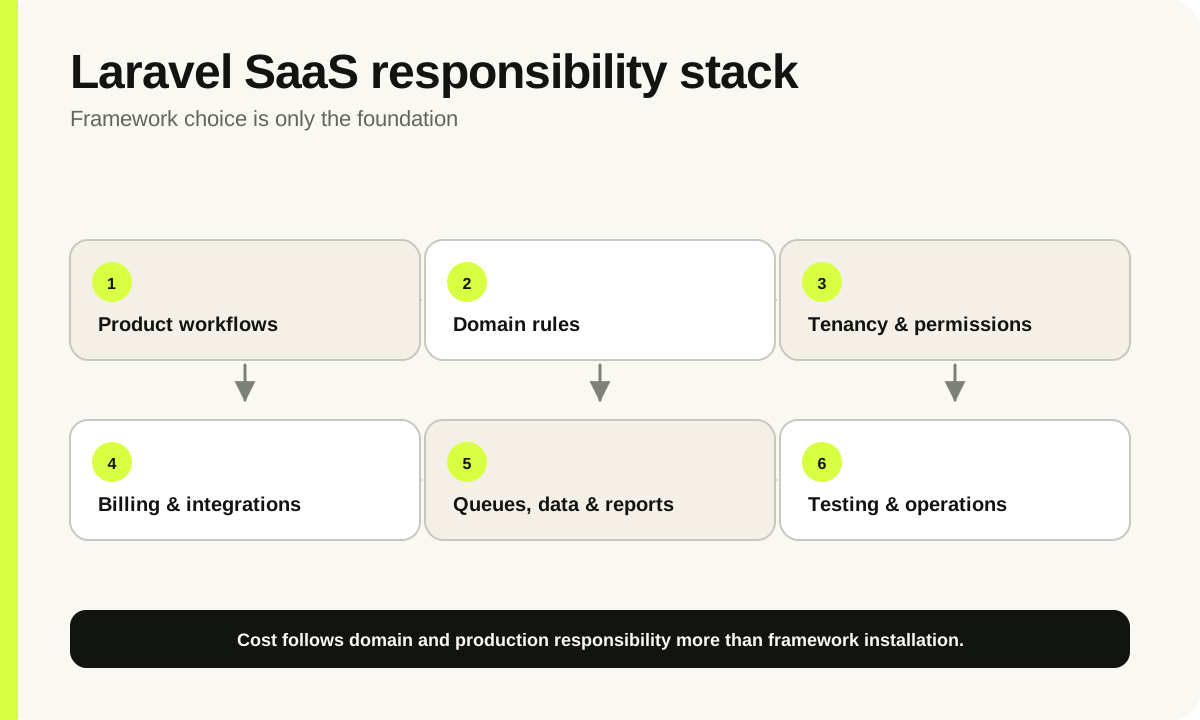
Laravel SaaS responsibility stack covering product workflows, domain rules, integrations, queues, data, testing, and operations
Laravel cost follows the product and operational responsibilities built around the framework.

4–8 weeks

Focused App or Internal Tool

≈$1,500–$5,000

BDT 2–6 lakh

A defined workflow for one organization, a focused customer portal, an operational dashboard, or a bounded API with a small number of roles and integrations.

Assumes

  • One primary workflow
  • Limited roles and integrations
  • Usable source data
  • Normal business-hours launch

What moves the estimate

  • Approval depth
  • Import quality
  • Reporting detail
  • External API reliability

10–20 weeks

SaaS MVP

≈$5,000–$14,500

BDT 6–18 lakh

A customer-facing product with organizations or tenants, subscriptions or billing, role-based access, onboarding, notifications, integrations, and an operational administration layer.

Assumes

  • Prioritized first-release scope
  • Known billing model
  • Named acceptance owner
  • Phased integrations where useful

What moves the estimate

  • Tenant isolation
  • Billing exceptions
  • API surface
  • Audit and reporting needs

5–12+ months

Complex Platform or Migration

≈$14,500–$40,500+

BDT 18–50+ lakh

A multi-domain platform, regulated or high-consequence workflow, large migration, integration hub, or replacement of an established system that must remain available during transition.

Assumes

  • Discovery before final milestones
  • Incremental releases
  • Access to incumbent systems
  • Business participation in migration acceptance

What moves the estimate

  • Legacy behavior
  • Data reconciliation
  • Parallel operation
  • Security and availability targets
Planning range summary. BDT is the commercial source of truth; USD is rounded for comparison.
Delivery tier USD planning range BDT planning range Planning window
Focused App or Internal Tool ≈$1,500–$5,000 BDT 2–6 lakh 4–8 weeks
SaaS MVP ≈$5,000–$14,500 BDT 6–18 lakh 10–20 weeks
Complex Platform or Migration ≈$14,500–$40,500+ BDT 18–50+ lakh 5–12+ months

02

What a Laravel estimate is measuring

Laravel provides mature capabilities for routing, validation, queues, events, authentication, testing, deployment, and many other application concerns. It does not remove the work of defining a business system correctly.

A quote based on screens or database tables misses the expensive part: behavior. For each important workflow, define who can start it, which state changes are allowed, what happens on failure, whether actions can be reversed, what is recorded, and who resolves exceptions. A ten-screen product with difficult rules can require more engineering than a fifty-screen content system.

The intended operating life also matters. A validation build can accept deliberate boundaries. A revenue-generating product expected to support new teams, audit requirements, integrations, and years of change needs stronger domain boundaries, test coverage, observability, documentation, and deployment controls from the start.

Use the Laravel SaaS development service for delivery scope, the general software cost guide for technology-neutral budgeting, and the MVP service when the first release still needs product validation.

Laravel scope areas and the questions that affect cost
Scope area Lower-complexity shape Cost-driving shape
Domain rules A short, stable workflow Many states, exceptions, approvals, reversals, or calculations
Users and tenancy One organization and a few roles Tenant isolation, delegated administration, impersonation, or custom roles
Billing No billing or one simple plan Trials, upgrades, proration, usage, invoices, tax, failed-payment recovery, or credits
Integrations and APIs One documented synchronous API Multiple providers, webhooks, retries, rate limits, reconciliation, and public versioned APIs
Data Clean import with a known mapping Large, inconsistent legacy data requiring transformation, deduplication, and rollback
Operations Normal traffic and office-hours support Queues, scheduled jobs, search, high availability, detailed audit, and incident obligations

03

Tenancy, permissions, and billing

SaaS complexity often begins with organization boundaries. “Users can belong to companies” is not a complete tenancy design.

The scope must define whether a user can belong to several organizations, whether data is shared, how invitations and ownership transfer work, what a support operator may see, and how every query, export, notification, job, cache entry, and uploaded file preserves the boundary. Retrofitting tenant isolation after launch can be substantially more expensive than designing it deliberately.

Roles are similarly contextual. A fixed administrator/member split is different from per-organization roles, resource-level permissions, approval limits, temporary access, or a complete audit trail. The estimate should name the important decisions and security tests instead of promising generic “role-based access.”

Subscription billing adds a lifecycle, not merely a checkout page. Trials, coupons, plan changes, proration, usage limits, invoices, gateway webhooks, payment failures, cancellation, reactivation, tax evidence, entitlement changes, and finance reconciliation must agree. Binnash scopes the applicable lifecycle and treats gateway fees and provider charges as separate operating costs.

04

APIs, integrations, queues, and reporting

External systems make a Laravel product depend on behavior outside the project team’s control. Reliable integration work includes failure and recovery paths.

Queues are appropriate for email, imports, media processing, third-party synchronization, expensive reports, and other work that should not delay a request. They introduce operational questions: uniqueness, ordering, retries, duplicate effects, poison messages, monitoring, and safe deployment while jobs are active. Those responsibilities should be estimated explicitly.

Reporting can become its own product domain. Identify which values are authoritative, whether results must be real-time, how permissions apply, expected data volume, export formats, and how historical definitions behave when business rules change. “Dashboard and reports” is not enough information for a credible milestone.

Integration scope

  • Authentication and permission model
  • Rate limits and timeout behavior
  • Webhook verification and idempotency
  • Retries, dead-letter handling, and reconciliation
  • Sandbox quality and production access
  • Version change and provider-support responsibility

Operational scope

  • Queue and scheduler monitoring
  • Failure alerts with actionable context
  • Audit and business-event history
  • Report definitions and export limits
  • Backup and restore responsibilities
  • Runbooks for common launch incidents

05

New build, inherited codebase, or migration

An existing Laravel repository is not automatically cheaper than a new build. It first needs a bounded technical and product assessment.

The assessment should run the application, inspect recent change patterns, review automated tests, identify unsupported dependencies, understand production deployment, and trace at least one relevant workflow. Code style alone does not reveal operational risk. Database size, data correctness, external contracts, security exposure, and the team’s ability to explain production behavior matter more.

For migrations, “move everything” is not an acceptance criterion. Agree source-to-target mappings, invalid-record policy, historical retention, file handling, reconciliation totals, rehearsal process, freeze window, rollback threshold, and the owner who signs off. A phased coexistence plan can reduce risk even when it extends the calendar.

Hosting location should follow user latency, data obligations, provider capability, operational access, and total cost—not the development team’s office. A Bangladesh team can operate regional or global infrastructure, but the proposal should name the selected region, backup location, billing owner, observability, recovery objective, and any foreign-currency provider costs.
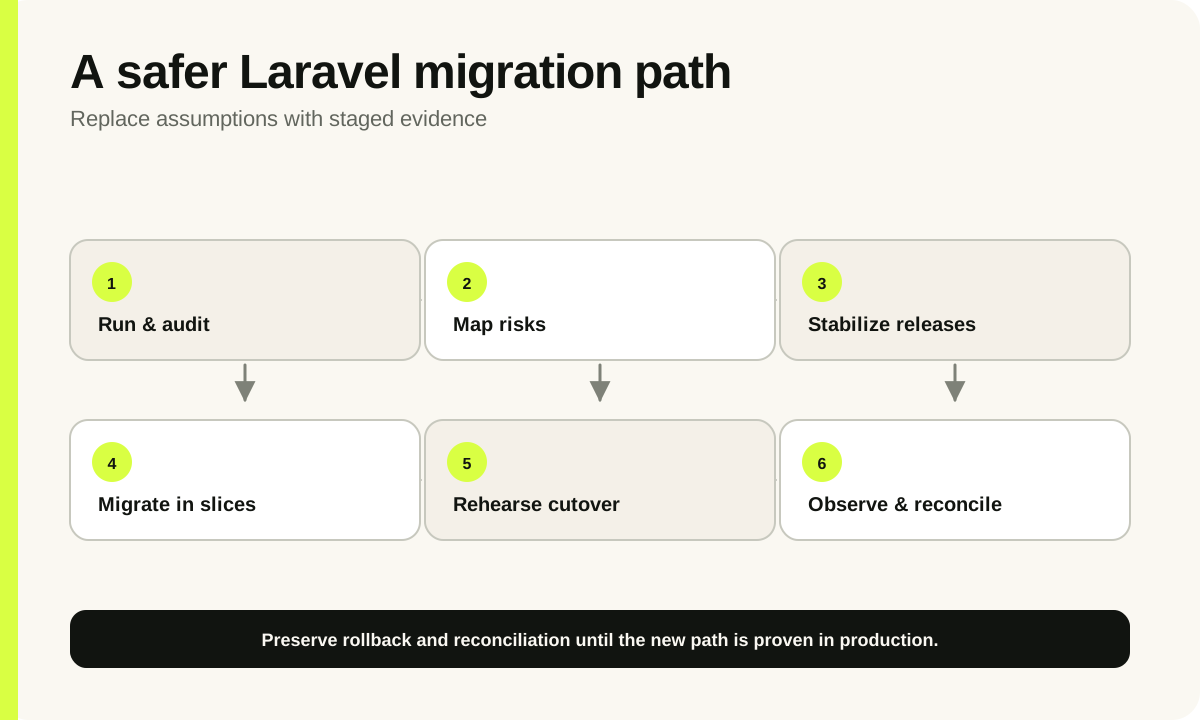
Laravel migration path from audit and risk map through stabilization, staged migration, cutover, and observation
Inherited systems should move through evidence, stabilization, staged change, and observable cutover.
How Binnash approaches different starting points
Starting point First step Planning implication
New product Clarify outcome, release boundary, architecture, and acceptance Estimate can follow prioritized workflows and stated assumptions
Healthy existing product Review architecture, tests, deployment, dependencies, and requested domain Feature milestone can include targeted hardening
Uncertain legacy code Time-boxed audit plus representative change or test Do not promise a fixed feature price before evidence
Framework or platform migration Inventory behavior, data, integrations, URLs, jobs, reports, and cutover constraints Treat parity, migration, rehearsal, rollback, and post-cutover verification as work

06

What is included, excluded, and accepted

A Binnash build range assumes a complete delivery baseline, but the proposal narrows that baseline to the actual project.

Necessary UX/UI means enough product and interface work to make the scoped workflows usable. It does not imply a new brand system, unlimited design exploration, marketing production, or content creation. Scope-appropriate testing can include unit, feature, integration, contract, or browser coverage according to risk; a proposal should not promise a meaningless coverage percentage without explaining the tested behavior.

The included 90 days cover correction of defects against accepted scope and launch stabilization. New features, altered business policy, provider changes, new platform versions, capacity expansion, around-the-clock support, and continuing roadmap delivery are separate. Acceptance criteria and defect reporting should be agreed before the milestone is built.

Included baseline

  • Discovery and written scope
  • Necessary product UX and interface design
  • Engineering and scope-appropriate automated testing
  • Production deployment, documentation, and handover
  • 90 days of defect correction and launch stabilization

Usually separate

  • Applicable taxes and third-party licenses
  • Cloud, hosting, payment gateway, or provider usage charges
  • Brand identity, photography, copywriting, and bulk content entry
  • Unlisted migration, compliance, or integration work
  • New features and ongoing maintenance after launch

07

How Binnash turns scope into a quote

The estimate begins with user outcomes and operational constraints, then converts them into demonstrable milestones.

Binnash identifies actors, workflows, domain rules, data, integrations, quality requirements, release constraints, and unresolved assumptions. High-risk unknowns may become a short discovery or technical proof before the remaining milestones are fixed. The proposal states the scope boundary, payment schedule, client dependencies, inclusions, exclusions, and change process.

Defined builds normally use scoped milestone pricing. Monthly product-engineering engagements are available where priorities need to evolve continuously, but there is no public monthly rate because team composition and responsibility differ. Monthly work should still have an ordered backlog, decision owner, delivery cadence, quality baseline, and transparent progress—not an undefined pool of hours.

A useful quote also describes production: environments, deployment ownership, backups, monitoring, error visibility, queue operations, secrets, access, handover, and launch. The cheapest implementation price is not a saving if nobody can release, observe, or safely change the system afterward.

Sources

Authoritative references

External facts and conversion guidance should be checked against these primary sources at decision time.

FAQ

Useful questions, answered directly.

How much does Laravel development cost at Binnash?

Indicative ranges are $1,500–$5,000 (BDT 2–6 lakh) for a focused application or internal tool, $5,000–$14,500 (BDT 6–18 lakh) for a SaaS MVP, and $14,500–$40,500+ (BDT 18–50+ lakh) for a complex platform or migration. The proposal confirms scope and responsibility.

Is Laravel a good choice for a SaaS product?

Yes when a product needs structured business workflows, APIs, background jobs, integrations, billing, permissions, and a maintainable server-side application. The decision should also consider the team, hosting model, existing systems, real-time needs, and long-term operating responsibility.

Does the Laravel price include frontend development?

The planning tiers include the necessary product UX/UI and frontend engineering for the accepted workflows. A proposal states whether that means server-rendered Blade, Livewire, an API-backed application, or another interface. Brand identity, marketing content, and unlimited design exploration are separate.

Can Binnash take over an existing Laravel application?

Yes, after enough assessment to understand the repository, dependencies, tests, deployment, data, integrations, security, and requested change. A healthy codebase may move directly to a milestone; uncertain legacy systems usually need a time-boxed audit before a reliable fixed scope.

How is a Laravel migration estimated?

The estimate covers behavior parity, data mapping and cleansing, files, integrations, background work, reports, testing, rehearsal, cutover, rollback, and verification. Source-system access and a business owner who can approve reconciled results are necessary planning inputs.

What happens after the included 90-day support period?

The application and agreed source code are handed over according to the proposal. New roadmap work, dependency upgrades, monitoring response, hosting operations, and maintenance can be handled through a separate scoped milestone or monthly engagement.

What should I send for a Laravel estimate?

Send the business outcome, user types, key workflows, role and tenant rules, billing model, integrations, data or legacy system, expected usage, security obligations, desired launch window, budget band, and access to an existing repository or documentation where applicable.

Start with context

Have a product decision to make?

Share the current stage, constraint, timeline, and approved budget band. The senior team will reply with the right next step.

Send a project brief