Software buyer guide · Bangladesh

Ecommerce development in Bangladesh: price the operating system, not the storefront.

Binnash planning ranges for ecommerce development are about $1,500–$4,000 (BDT 2–5 lakh) for a defined Shopify or WooCommerce build, $4,000–$12,000 (BDT 5–15 lakh) for custom commerce, and $12,000–$28,500+ (BDT 15–35+ lakh) for an integration-heavy platform. Catalogue, checkout, payments, inventory, fulfilment, migration, operations, analytics, and traffic determine the actual quote.

Start a project

By Nazmul Alam · Reviewed

01

Ecommerce project planning ranges

These ranges describe Binnash engineering responsibility. They are not Bangladesh market averages and do not include the continuing cost of running a store.

The USD figures use the Bangladesh Bank average exchange rate of BDT 123.6969 per USD for 22 July 2026 and are rounded to the nearest $500. BDT remains the source of truth. Platform subscriptions, paid apps, payment fees, messaging, hosting, and consumption-based services remain separate unless a proposal names a temporary allowance.

New builds and substantial feature engagements start at BDT 1.5 lakh. A store audit, analytics review, checkout diagnosis, performance investigation, or small maintenance request can be quoted separately without forcing it into a build tier.

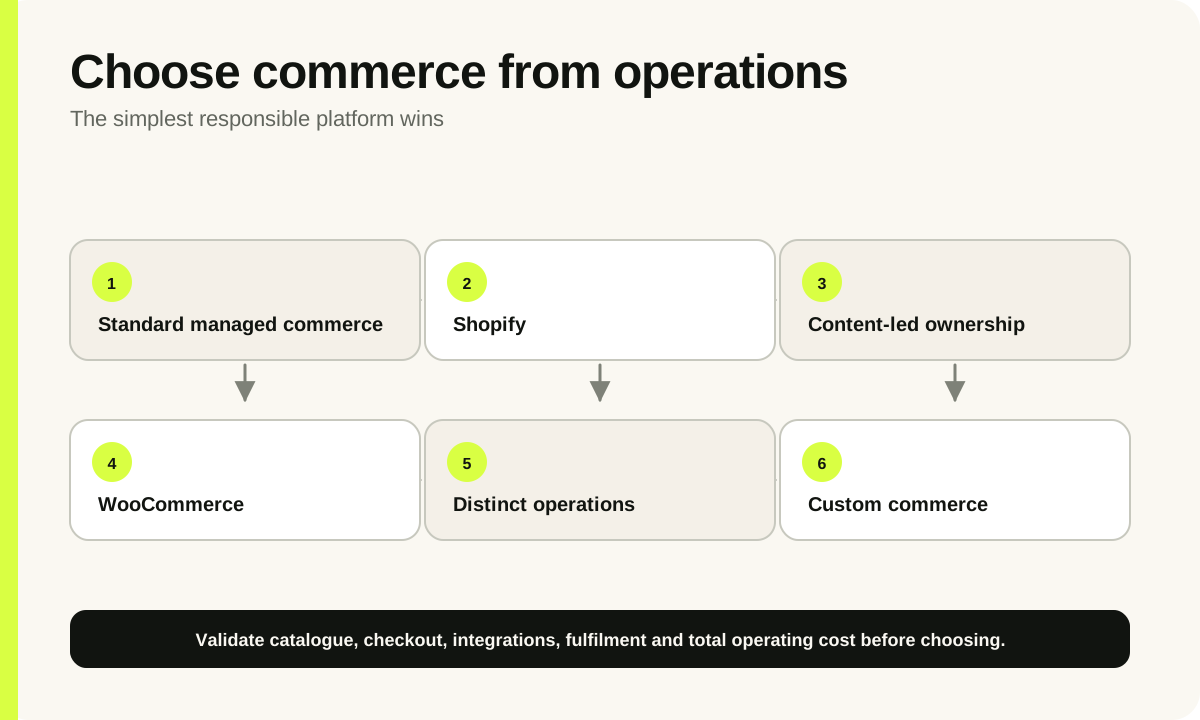
Decision tree comparing Shopify, WooCommerce, and custom commerce by workflow fit, content needs, and integration complexity
Choose the simplest platform that supports the real operating model without fragile workarounds.

3–6 weeks

Shopify or WooCommerce Commerce Build

≈$1,500–$4,000

BDT 2–5 lakh

A focused catalogue using standard platform capabilities, a defined design system, one primary market, conventional checkout, and a small number of proven integrations.

Assumes

  • Clean product data
  • Standard checkout behavior
  • Content supplied on time
  • Merchant accounts ready

What moves the estimate

  • Theme depth
  • Variant complexity
  • Payment setup
  • Migration volume

8–16 weeks

Custom Commerce

≈$4,000–$12,000

BDT 5–15 lakh

A differentiated storefront or commerce workflow with custom catalogue behavior, search and filtering, promotions, customer accounts, operations, or several integrations.

Assumes

  • Prioritized first release
  • Defined operational workflow
  • Documented integration access
  • Representative catalogue available

What moves the estimate

  • Search behavior
  • Promotion rules
  • Inventory sources
  • Account and checkout customization

4–8+ months

Integration-Heavy Platform

≈$12,000–$28,500+

BDT 15–35+ lakh

A multi-channel or operational platform connecting ERP, warehouse, fulfilment, marketplace, complex pricing, large migration, high traffic, or custom merchant workflows.

Assumes

  • Discovery before final milestones
  • System-owner participation
  • Incremental migration and launch
  • Reconciliation criteria agreed

What moves the estimate

  • System-of-record conflicts
  • Order orchestration
  • Catalogue scale
  • Availability and peak-load targets
Planning range summary. BDT is the commercial source of truth; USD is rounded for comparison.
Delivery tier USD planning range BDT planning range Planning window
Shopify or WooCommerce Commerce Build ≈$1,500–$4,000 BDT 2–5 lakh 3–6 weeks
Custom Commerce ≈$4,000–$12,000 BDT 5–15 lakh 8–16 weeks
Integration-Heavy Platform ≈$12,000–$28,500+ BDT 15–35+ lakh 4–8+ months

02

Choose the platform from the operating model

Shopify, WooCommerce, and custom engineering can all produce a good storefront. The right choice depends on how the merchant sells and operates after launch.

Choose Shopify when standardization is commercially helpful. Its managed core can shorten launch and reduce infrastructure responsibility, while custom themes, extensions, and integrations still allow differentiation. Confirm that required checkout behavior, markets, payments, product rules, and applications work on the intended plan before committing.

Choose WooCommerce when publishing and commerce need to share WordPress, the team values ownership of the application, and the operational requirements fit a maintainable extension set. More control also means responsibility for hosting, updates, plugin compatibility, security, performance, backups, and incident response.

Choose custom engineering when the operation itself is the product advantage or when forcing the workflow through extensions would create brittle dependencies. Custom does not mean rebuilding commodity capabilities without reason; it can combine a platform for standard commerce with purpose-built services for the differentiated domain.

Binnash scopes implementation through its ecommerce engineering service . Compare a content-led store with the WordPress and WooCommerce guide , and use the general software cost guide when commerce is only one part of a larger product.

Shopify, WooCommerce, and custom commerce comparison
Decision area Shopify WooCommerce Custom engineering
Best fit Standard commerce with managed platform operations and a strong app ecosystem Content-led commerce where WordPress ownership and controlled extensions are useful Distinct workflows or integrations that standard platforms cannot support safely
Catalogue Strong conventional products and variants within platform limits Flexible WordPress content plus WooCommerce product modeling Purpose-built data model for unusual products, pricing, or relationships
Checkout and payments Reliable hosted path with platform and plan constraints More control, with plugin, hosting, and update responsibility Maximum control and maximum compliance, reliability, and maintenance responsibility
Extensions Apps can accelerate delivery but add subscriptions and vendor dependency Plugins can accelerate delivery but require compatibility and security governance Integrations are engineered and owned as explicit product capabilities
Operations Managed core platform reduces infrastructure work Merchant or partner owns WordPress hosting, updates, backups, and security Product owner funds complete application and infrastructure operations
Change risk Platform changes and app contracts Plugin/theme conflicts and upgrade discipline Engineering capacity, architecture, tests, and operational maturity

03

Catalogue, discovery, and product data

Catalogue size alone is a poor cost measure. Structure, data quality, merchandising behavior, and change frequency are more informative.

Define products, variants, bundles, options, collections, attributes, price lists, stock states, media, downloadable assets, and relationships. A merchant with 20 configurable products can have more modeling work than one with 5,000 simple SKUs. Product information arriving from spreadsheets, suppliers, an ERP, or several teams needs ownership and validation rules.

Discovery includes navigation, search, filters, sorting, synonyms, empty-result handling, recommendations, and merchandising controls. Agree which attributes are filterable, how URLs behave, what must be indexable, how out-of-stock products appear, and who can tune results. Large or rapidly changing catalogues may require a dedicated search service and synchronization monitoring.

Migration should define transformations, duplicate policy, image handling, variants, customers, consent, orders, redirects, reviews, and reconciliation. Content cleanup and product enrichment are business work even when engineering provides import tooling. A sample migration early in the project reveals more than counting rows.
04

Checkout, payments, promotions, and customer accounts

Checkout is a stateful commercial workflow. Small changes can affect conversion, fraud, finance, support, privacy, and payment compliance.

Payment integration includes more than opening a hosted payment page. Scope success and failure returns, signed webhooks, duplicate events, delayed confirmation, abandoned orders, reconciliation, partial and full refunds, chargebacks, and support visibility. Payment gateway fees and settlement terms belong to the merchant, while Binnash can implement and test the agreed integration.

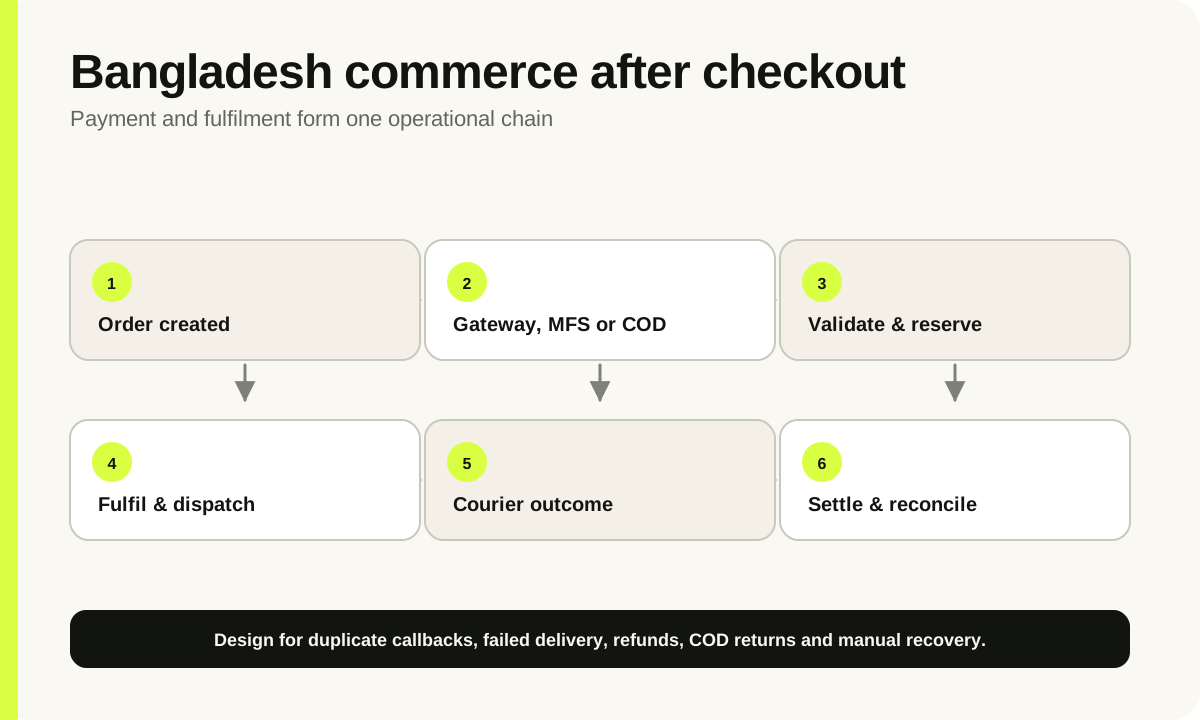
For Bangladesh-facing checkout, options may include a direct mobile financial service integration such as bKash, an authorized payment gateway such as SSLCOMMERZ, cards, bank payments, and cash on delivery. Availability depends on merchant onboarding and the provider’s current product. Budget sandbox work, production credentials, transaction validation, callback or IPN handling, refunds, settlement reconciliation, courier status, failed delivery, and returned cash-on-delivery orders as connected operational states.

Promotions need precedence and examples. “Buy two, get one,” category exclusions, customer-specific price lists, coupon stacking, free-shipping thresholds, and partial returns can interact in surprising ways. Write representative baskets and expected totals before implementation; they become acceptance and regression cases.

Checkout decisions

  • Guest versus required account
  • Addresses, delivery zones, and pickup
  • Payment methods and failure recovery
  • Tax, currency, invoice, and refund behavior
  • Stock reservation and overselling policy
  • Consent, fraud review, and customer communication

Commercial rules

  • Coupons and eligibility
  • Automatic and stacked discounts
  • Bundles, gifts, and quantity pricing
  • Customer group or channel price lists
  • Returns, cancellations, and store credit
  • Who can approve exceptional adjustments

05

Inventory, fulfilment, and merchant operations

The storefront cannot be estimated responsibly without understanding what happens from purchase to delivery, return, or cancellation.

Integration-heavy projects become expensive when systems disagree and nobody owns resolution. The scope should identify each system of record, synchronization direction, timing, duplicate handling, retry policy, alert, and manual recovery path. A dashboard that exposes failed orders can be more valuable than another automated retry.

Operational users need deliberately designed tools. Bulk actions, exports, reprocessing, stock correction, refund approval, order notes, and customer communication require permissions and audit history. Leaving these workflows to direct database access creates avoidable launch risk and support cost.

Bangladesh ecommerce operations flow from checkout through payment or cash on delivery, order validation, fulfilment, courier status, settlement, and reconciliation
Local commerce scope includes operational states after checkout—not only the payment button.
Operational questions that shape ecommerce engineering
Operation Questions to settle Typical engineering consequence
Inventory Which system is authoritative? Are there locations, reservations, backorders, or bundles? Synchronization, conflict policy, monitoring, and reconciliation
Order routing Who fulfils each item and when can an order split? State machine, partial shipment, notifications, and support tooling
Delivery How are zones, rates, labels, tracking, pickup, and failed delivery handled? Carrier integration and exception workflows
Returns What can be returned, approved, restocked, refunded, or exchanged? Permissions, payment actions, inventory effects, and audit
Customer service What can support view or change safely? Search, impersonation policy, notes, controlled actions, and history
Finance How are orders, settlements, fees, tax, refunds, and channels reconciled? Exports or accounting integration with consistent identifiers

06

Performance, analytics, and launch readiness

Commerce performance is a whole-page and whole-system property: theme code, images, fonts, scripts, apps, personalization, search, caching, APIs, and infrastructure all contribute.

Google’s Core Web Vitals provide useful user-experience thresholds for loading, responsiveness, and visual stability, but a launch plan also needs representative devices, network conditions, catalogue pages, search results, cart, and checkout. Synthetic scores cannot replace real-user monitoring after traffic arrives.

Analytics scope should name the decisions the data supports. Define product views, search, promotion exposure, add-to-cart, checkout stages, payment outcomes, refunds, consent behavior, campaign attribution, and server-side events where appropriate. Test identifiers and revenue totals against the commerce source rather than assuming a tag firing means correct measurement.

Peak planning needs an expected traffic shape, marketing events, catalogue update behavior, cache strategy, integration capacity, rate limits, and a response owner. The platform may absorb infrastructure scaling while an app, custom service, search provider, or ERP remains the bottleneck.

07

What the range includes—and what keeps recurring

The build range covers a scope-appropriate path to production. Commerce has material operating costs that should remain visible beside the engineering budget.

A proposal should state the catalogue sample, platform and plan, environments, integrations, migration volume, design responsibility, analytics, performance approach, client-supplied content, acceptance cases, launch sequence, and handover. The included 90 days cover defects against accepted scope and launch stabilization—not continuing merchandising, content operations, provider changes, or a new roadmap.

Defined projects use scoped milestone pricing. Monthly product-engineering support is available for continuous experimentation, operations, and roadmap work, but no public monthly rate is presented because the required team and responsibility differ. The engagement should still define outcomes, cadence, access, and service boundaries.

Included baseline

  • Discovery and written scope
  • Necessary product UX and interface design
  • Engineering and scope-appropriate automated testing
  • Production deployment, documentation, and handover
  • 90 days of defect correction and launch stabilization

Usually separate

  • Platform plans and paid applications
  • Gateway, transaction, messaging, and currency fees
  • Hosting, search, CDN, and consumption charges
  • Branding, copy, product data, photography, and content entry
  • Warehouse, fulfilment, courier, and customer-service operations
  • Unlisted data cleanup or integration work
  • New features and ongoing maintenance after launch

Sources

Authoritative references

External facts and conversion guidance should be checked against these primary sources at decision time.

FAQ

Useful questions, answered directly.

How much does ecommerce development cost at Binnash?

Indicative ranges are $1,500–$4,000 (BDT 2–5 lakh) for a Shopify or WooCommerce build, $4,000–$12,000 (BDT 5–15 lakh) for custom commerce, and $12,000–$28,500+ (BDT 15–35+ lakh) for an integration-heavy platform. Discovery confirms the platform and scope.

Should I choose Shopify, WooCommerce, or a custom store?

Choose Shopify for conventional commerce with a managed core, WooCommerce for maintainable content-led commerce with WordPress ownership, and custom engineering when differentiated workflows or integrations cannot fit safely in a standard platform. Validate required payments, checkout, operations, and total operating cost.

Are platform subscriptions and payment gateway fees included?

No. Shopify or other platform plans, paid applications, WordPress licenses, hosting, gateways, transaction fees, messaging, search, CDN, and other consumption charges are separate unless a proposal names a temporary allowance.

Can Binnash migrate products, customers, and orders?

Yes, when the proposal defines source access, mappings, cleanup responsibility, variants, images, consent, historical orders, redirects, reconciliation, rehearsals, and acceptance. Large or inconsistent data can move a project into a higher tier.

Does an ecommerce build include product photography and content entry?

Not by default. Engineering can provide the content model, templates, import tools, and agreed sample entry. Branding, copywriting, photography, product enrichment, bulk content operations, and ongoing merchandising are separately owned unless explicitly scoped.

How does Binnash test checkout and payments?

Testing follows the agreed risk: representative baskets, promotions, inventory, delivery, payment success and failure, signed webhooks, duplicate events, refunds, permissions, analytics, and browser behavior. Production readiness also depends on merchant accounts and provider test environments.

What should I prepare for an ecommerce estimate?

Provide markets, products and variants, sample catalogue data, customer types, payment and delivery methods, promotions, inventory and fulfilment workflow, integrations, migration sources, expected traffic, design and content status, launch date, budget band, and current pain points.

Start with context

Have a product decision to make?

Share the current stage, constraint, timeline, and approved budget band. The senior team will reply with the right next step.

Send a project brief